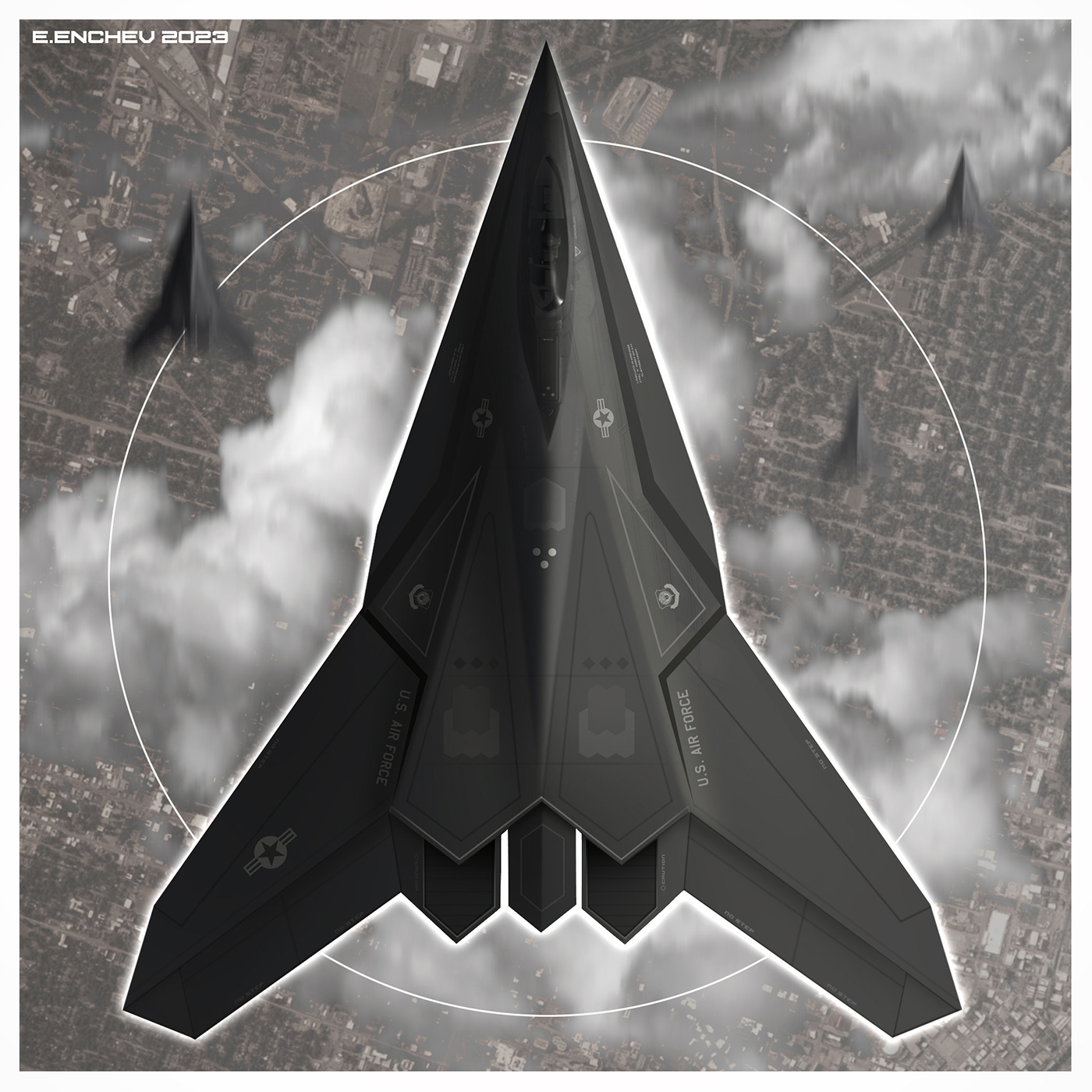



DOMINANCE THROUGH PROPAGATION CONTROL
Traditional stealth minimizes reflected energy magnitude. T7DP controls the continuity, phase, and coherence of propagation across all sensing domains — shaping how observers experience reality, not merely what they receive.
- Radar propagation — phase discontinuity and return fragmentation
- Infrared propagation — centroid drift and thermal signature collapse
- Optical propagation — silhouette incoherence and specular suppression
- Acoustic propagation — temporal alignment destabilization
- Networked sensor fusion propagation — cross-observer inconsistency
- Temporal alignment propagation — observer time-disagreement induction
7-LAYER DOMINANCE ARCHITECTURE
TRILLY-PURE ADAPTIVE CONTINUITY SKIN
The aircraft skin is a multi-layer adaptive propagation structure. Each sublayer operates on a distinct sensing domain, collectively collapsing all observer modalities.
LAYER A — STRUCTURAL METAMATERIAL LATTICE
Provides mechanical integrity while enabling propagation tuning. Controls impedance, reflectivity phase offset, and spectral shaping across radar bands.
LAYER B — PHASE-ADAPTIVE PROPAGATION MESH
Nanostructured phase manipulators actively control phase delay, scattering geometry, and coherence fragmentation. Not absorbing radar — breaking its ability to reconstruct geometry.
LAYER C — THERMAL PROPAGATION DIFFUSER
Thermal emissions redistributed spatially and temporally. Induces IR centroid drift, thermal signature flattening, and non-physical temperature distributions. Infrared tracking fails to maintain lock continuity.
LAYER D — OPTICAL PROPAGATION DISRUPTOR
Controls visible light propagation via specular suppression, structured diffusion, and viewpoint-dependent silhouette distortion. Visual lock becomes unstable.
τ∞ CONTINUITY FIELD STABILIZATION
τ∞ represents maximum continuity control stability. At τ∞ state:
- Propagation coherence fully controlled
- Observer-dependent reality divergence maximized
- Track stability mathematically impossible
The aircraft exists physically. But no observer can form a consistent model.
T7DP vs LEGACY 5TH GEN
| METRIC | LEGACY 5TH GEN | T7DP |
|---|---|---|
| Radar cross-section | Reduced | Observer-dependent, non-resolvable |
| Infrared tracking | Reduced | Centroid unstable |
| Optical visibility | Reduced | Geometry coherence broken |
| Sensor fusion vulnerability | Moderate | Fusion impossible |
| Track stability | Reduced | Non-maintainable |
| Detection probability | Low | Non-deterministic |
| Engagement probability | Possible | Collapse-prone |
ENGAGEMENT LIFECYCLE COMPARISON
AIR SUPERIORITY REDEFINED
Air superiority is no longer achieved by speed, maneuverability, or stealth magnitude.
It is achieved by: continuity control dominance.
The side that controls propagation coherence controls detection reality.
PLATFORM CLASSIFICATION
T7DP is not a fighter.
Aircraft is merely the physical carrier. Dominance comes from controlling how observers can construct reality around it.